Garden guide
Staying Safe on Your Garden Project
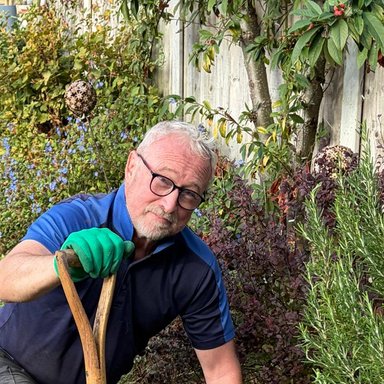
Written with Paul. A full-time working gardener. After years in the City, Paul packed it all in, retrained at Writtle College, and has gardened for a living ever since. The “Paul” notes in this guide are his real advice from real jobs.
Ten minutes of thought beats a weekend in A&E
Garden projects feel harmless — that's exactly why they hurt people. The injuries are rarely dramatic: sunburn that quietly builds up over years, a slab edge across the toes, a spade through a trainer, a ladder that 'only needed five minutes'. None of the precautions in this guide cost much money or time. Paul recommends treating safety kit the same way you treat materials — sorted before the job starts, not fetched after the accident.
Sun protection — yes, even on grey British days
Up to 80% of UV gets straight through cloud, and in the UK the UV index sits at 3 or above — the level where protection is advised — from roughly April to September. UV damage is cumulative: an eight-hour Saturday laying a patio is eight hours of exposure, and it stacks up over a project and over a lifetime. Use a broad-spectrum SPF 30 or higher, put it on twenty minutes before you start, and reapply every two hours — sooner if you're sweating. Add a hat and decent sunglasses, and don't skip winter: low sun plus cold wind burns faces just as happily in February. Paul wears sun cream 365 days a year and keeps a spare tube in the van — he's gardened alongside enough older groundskeepers to see what a working lifetime of uncovered ears, necks and forearms does, and none of them saw it coming either.
Appropriate clothing for the job
Protective trousers and long sleeves aren't about looking the part — they take the scratches, thorns, strimmer debris and splashes so your skin doesn't. Wet cement is the one people learn about the hard way: it burns skin slowly and silently, so sleeves and gloves matter on any concrete or mortar day. If you're working on a driveway, a front garden or anywhere near traffic or delivery lorries, wear hi-vis — drivers are looking for cars, not gardeners. And keep everything fitted: no dangling hoodie cords, no loose sleeves, no scarves anywhere near a cement mixer, rotavator, shredder or any rotating machinery. Paul has seen serious injuries caused by exactly that — a loose cuff near moving machinery turns a routine afternoon into an ambulance ride in a fraction of a second.
Footwear — the most skipped safety kit there is
A 25kg bag of cement dropped from waist height, the corner of a 600mm slab, a railway sleeper shifting as you lower it — your toes are the first thing underneath all of them. Steel toe cap boots turn a broken foot into a bad word, and a proper midsole stops the nail you didn't see in the old decking timber. Trainers offer none of that, and sandals or flip-flops on a materials job are an injury with a date on it. In Paul's experience on site, foot injuries are the most common ones he sees — and every single one was somebody who was 'just moving a few slabs'. Decent boots also grip properly on wet grass and loose gravel, which prevents half the slips before they start.
Tool safety — check it, hold it right, put it away right
Check every tool before you use it: a loose hammer head or a split spade shaft will always pick the worst moment to let go. Sharp tools are safe tools — a blunt blade makes you force and swing harder, which is when control goes. Carry spades, forks and cutting tools blade-down at your side, cut away from your body, and never leave a rake or fork tines-up on the ground — the garden's oldest joke is only funny in cartoons. Digging is legs and rhythm, not back and heaving. When you finish, store tools dry, locked and out of children's reach, and keep power tools on an RCD-protected supply. Paul's advice after years of project work: the five minutes you spend checking kit before a job is the cheapest insurance you'll ever buy — every tool failure he's witnessed gave a warning somebody ignored.
Ladders and working at height
A ladder is right for short, light, low jobs — thirty minutes or less, one storey, both hands free to work. Anything longer, heavier or higher wants a scaffold tower or proper scaffolding; hedge-trimming from the top of a ladder is a classic A&E admission. Set the base one unit out for every four up, make sure it's on firm level ground, and keep three points of contact at all times — two feet and a hand, or two hands and a foot. Never lean out so your belt buckle passes the stiles; climb down and move the ladder instead. And never work at height alone — have someone foot the ladder and within earshot the whole time. Paul has seen serious injuries caused by 'quick jobs' on ladders, and they share one thing: somebody was up there alone, stretching for the last bit rather than moving the ladder.
Paul's note
None of this is about wrapping a garden in red tape — it's the stuff Paul actually does on every job, from his own boots and sun cream to the ladder rule he won't break for anyone. In his experience, the difference between professionals and weekend injuries isn't strength or skill, it's habit: the kit goes on before the work starts, every single time, no matter how small the job looks. Do that and a garden project is exactly what it should be — satisfying, and finished in one piece.
Quick reference — the right kit for the job
| Situation | Minimum kit | Why it matters |
|---|---|---|
| Any outdoor work, Apr–Sep (and bright winter days) | SPF 30+ sun cream, hat, sunglasses | UV damage is cumulative — it builds up over the project, and over years |
| Handling slabs, concrete, aggregates, sleepers | Steel toe cap boots with midsole | One dropped slab edge breaks unprotected toes |
| Concrete or mortar work | Long sleeves, gloves, eye protection | Wet cement burns skin slowly and silently |
| Driveways, front gardens, near traffic or deliveries | Hi-vis vest or jacket | Drivers are watching for cars, not gardeners |
| Mixers, rotavators, shredders, strimmers | Fitted clothing, nothing loose or dangling | Loose fabric near rotating machinery grabs in a split second |
| Work above ground level | Correct ladder angle, three points of contact, a second person | Falls from height are the most serious garden injuries |
The pattern across every row: the protection is cheap and quick, and the injury it prevents is neither.